What Does It Take to Ride the Elite Road World Championships? Preparation and Performance
What Does It Take to Ride the Elite Road World Championships? Preparation and Performance
The World Championships is considered by many to be the pinnacle of cycling—a battleground where the best athletes represent their country, and the winner earns the rainbow stripes for the rest of their career. This competitive space is so selective that simply toeing the line is a major achievement earned through years of dedicated work.
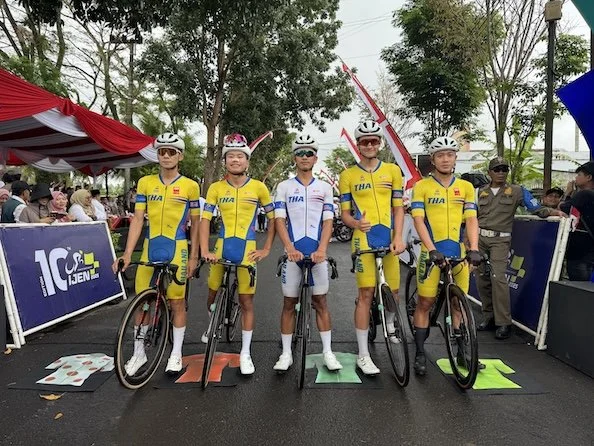
In late summer 2025, Training Edge Coaching athlete and Project Echelon rider Laurent Gervais received word that he was selected by Team Canada to race the Elite World Championships in both the Time Trial and Road Race in Kigali, Rwanda. This year, Training Edge athlete Judah Thompson earned the nod to represent Thailand in the World Championships U23 Road Race in Montreal.
In honor of both racers, let's break down what high-level preparation looks like and analyze the exact numbers required to compete against the best in the world.
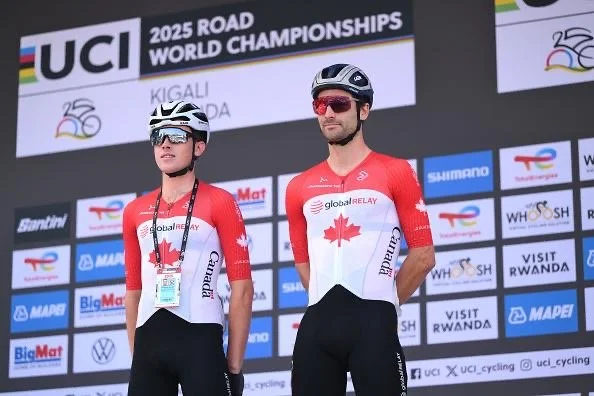
Laurent Gervais (right) representing Team Canada on stage at the World Championships in Kigali.
High-Level Preparation: Designing to the Specifics
When Laurent received his selection call, we immediately dialed in a plan targeting the specific physiological demands of the Kigali circuits.
Altitude (~4,700 ft / 1,430 m): Ahead of the race we did not have time to include a productive altitude camp, but we knew altitude would be a significant demand, so we did what we could to use heat exposure to get us as close to the mark as possible.
Heat Acclimation: Laurent was coming off of Volta Portugal which is regarded as one of the hottest stage races in the world (10 day stage race where temps can average in the 100F/37C). This gave us a big step forward to make sure he was fully heat acclimatized. Post-race we implemented post-ride thermal stress protocols for maintenance to make sure plasma volume stayed high to help reduce cardiovascular impact.
Technical Course Mastery: This course favored experienced riders who could save energy in small ways by using the course. We spent time chatting through ways of achieving energy conservation and “using the course” both in the RR and TT. A primary tool to achieve this was veloviewer as well as intel we received once he could pre-ride the course.
Variable Power Management: The Kigali course offered zero rhythm. Micro-burst training sessions were designed to prepare Laurent to absorb violent accelerations out of sharp corners and settle straight back into threshold power.
By the Numbers: Kigali 2025
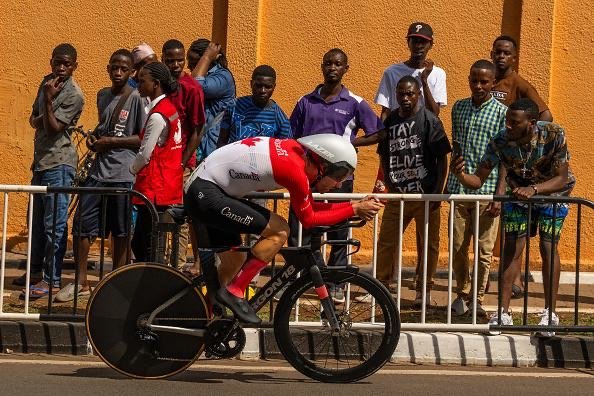
Total focus during the Elite Individual Time Trial.
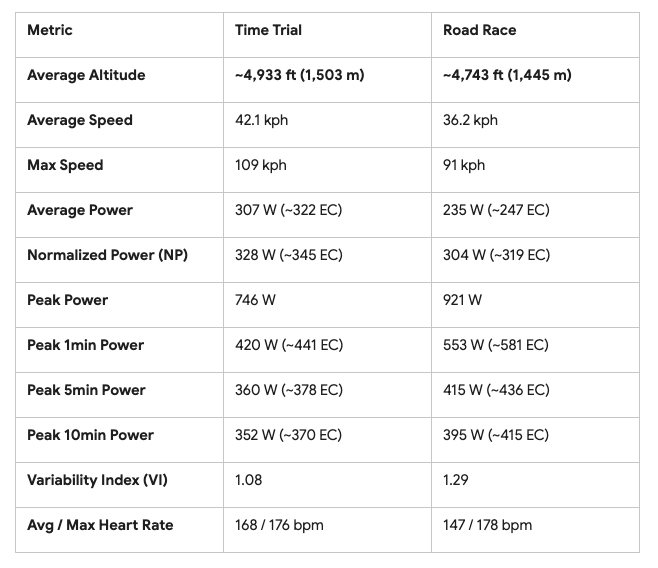
Comparing Laurent’s Time Trial and Road Race power files highlights the physiological contrast between the two efforts.
(EC = Elevation Correction)
Altitude Effect: The Hidden Penalty
Raw wattage on a screen doesn't tell the whole story. Performing at an average altitude of 4,743 feet (1,445 meters) fundamentally changes how power is produced and how the body recovers:
Aerobic Suppression (~5-7% Power Penalty): Lower available oxygen at altitude suppresses Vo2 Max. Producing a 328 W Normalized Power in Kigali required an internal physiological effort closer to ~345 W at sea level.
Road Race Demands
Variability Index (1.29 VI): While the TT required a more sustained output, the Road Race demanded extreme power fluctuations. A 1.29 VI, 700 W max sprint per lap and two 5-minute climbs per lap at an average of 380watts illustrate the constant and violent surges required to stay in the peloton on a hilly championship course against the best in the world.
Work & Vertical Gain: Absorbing nearly 8,000 feet of elevation gain while burning 2,809 kJ in the first 3.5 hours alone highlights the deep durability and massive endurance footprint required at the world level.
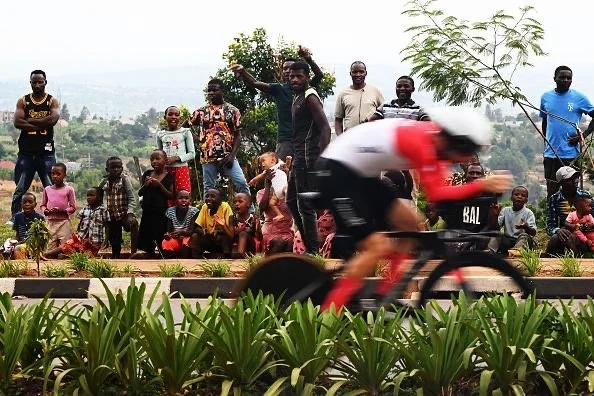
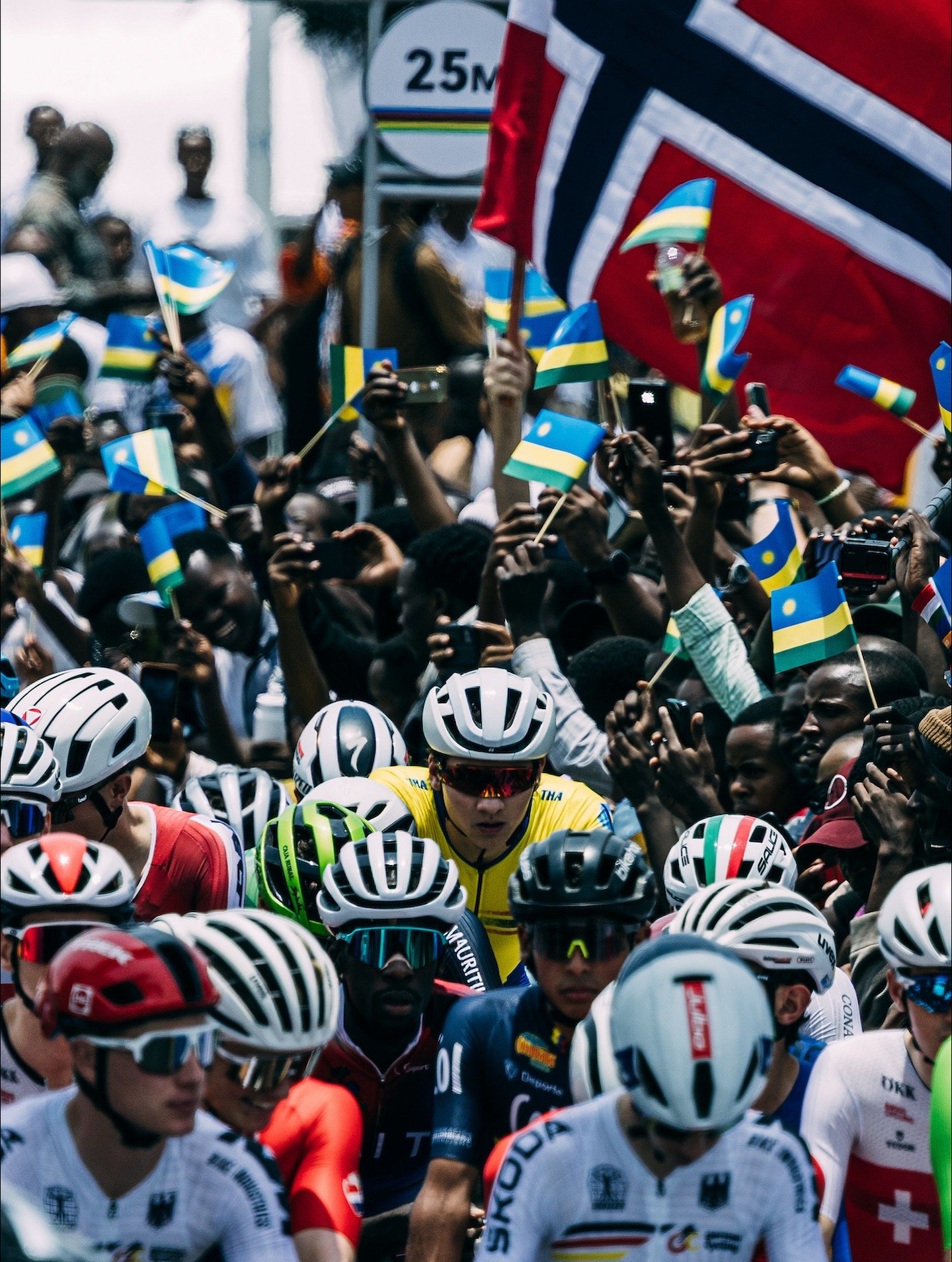
The immense atmosphere and relentless terrain of the Kigali circuit.
Time Trial Demands
Difficult Terrain: 40km with 2147feet (654m) of gain is what many would consider a very difficult TT course. This course consisted of two primary climbs, two smaller rollers, and technical downs coming off of each primary climb. We knew that this TT would come down to Laurent’s ability to ride the “red line” while at altitude, all while staying smooth and acing this technical course. While doing these efforts at sea level would have meant a above threshold over/under style effort, the altitude compressed that to a threshold/tempo style focus with key short sections to dig a bit more.
Speed: Not only was this course technical, but it was also high speed. A TT bike can feel very limiting until you get used to the narrow handling at high speed. To help with this potential limitation, we included as much time on the TT bike as possible and had focused workouts that incorporated technical terrain. Laurent’s max speed during the TT was 67.5mph (108.6kph) so this focus more than paid off on race day.
CDA (Coefficient Drag Area): Wind tunnel testing showed us what CDA was possible, but holding that position in demanding conditions (such as 67.5mph) is a very different story. Again time in position during demanding efforts was our secret to combatting this. Modeling after the race showed that Laurent was able to achieve an average CDA of 0.196 which is in range of what we knew was possible on this course.
Looking Ahead: Judah Thompson in Montreal
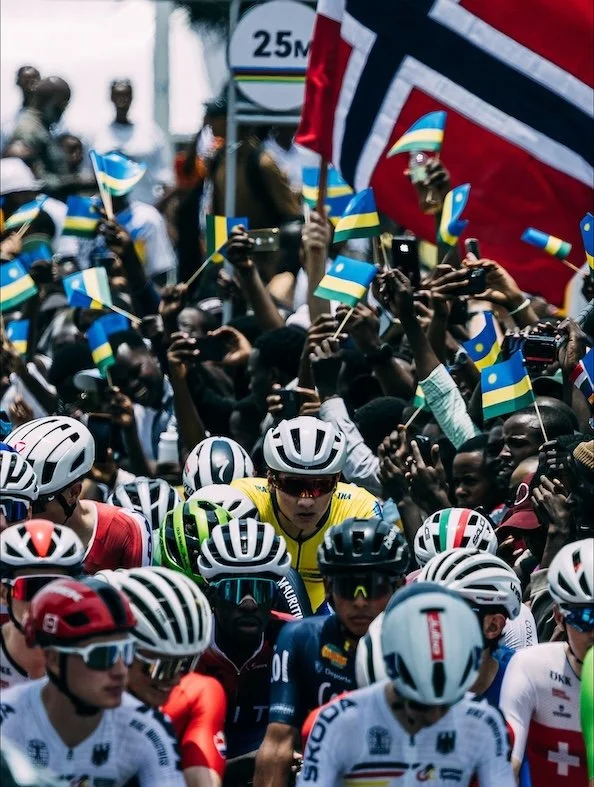
These metrics from Kigali provided a key benchmark for world-class performance. To prepare Judah Thompson for the U23 Road Race in Montreal, we applied these exact principles: surge repeatability, environmental readiness, and high-torque resiliency under pressure.
Montreal is an extremely undulating course where the U23 race holds 11,469feet (3,496m) over 174.5km. With no sections on the course that obviously will allow for rest, this will be a race of attrition from the start.
Toeing the line at the World Championships is an honor that is earned through relentless work. Join us in wishing Judah the best of luck as he takes on the world's best this week!
Follow him @judah_thompson

How Melisa Rollins won Steamboat Gravel : DATA Deep Dive
How Melisa Rollins won Steamboat Gravel : Data Deep Dive by Her Coach

Photo Credit Stephen Shelesky
Steamboat Gravel has long been a staple to the US gravel calendar, especially for the pro gravel circuit. The race stands out for its relentless climbing, smooth/fast gravel, stacked competition, and (with a change in format to a circuit) a taste for a road race on gravel.
This past Sunday, Melisa Rollins- one of my athletes- stepped onto the top step of the podium as the 2025 champion with a grin on her face and a stylish champions cowboy hat to show off.
She started the season with two broken wrists, so not only was this a prestigious win, but it was also a statement: she put setbacks behind her and showed what steady belief in the process and hard work will do.
This win especially stands out to me as it put to practice the tactical discussions Melisa and I have had, as well as the changes we have taken in her training recently.
Race data doesn’t always tell the full story, but in this case, we can actually extract quite a lot to see how the race was won (by the numbers).
The Race :
Women-only races have drastically changed the tactics for female winners of late, who used to race amongst the mens field. Because of this, a big focus for Melisa and I prior to each race has been chatting through race situations. We work together to lay out parameters and ideal situations, but planning can only do so much. A big part of any race is feeling out where your competition is at day-of.
At SBTG, during first lap, she tested the group with 4min at 328watts (5w/k) on the rollers. This effort ended up gapping the group (as we planned) and giving her the confidence to sit in, now knowing that she was one of the strongest riders in the race. It seems counter intuitive, but when you’re feeling good is when its hardest to stay patient and not waste your energy.
The next step was to watch the key players, watch for the moment they started hurting or exposed themselves, and then capitalize on it.
Over the course of the race, the group slowly whittled down due to the conditions (wind and heat) and pace. In the second lap the group trimmed quite a bit. Melisa did 30min at 243watts (.86IF) during this section. Long sections of high tempo did grind on the group, but this is when the training sessions we have been focusing on likely paid off. We have been focusing on fatigue resistance sessions that include intensity spread throughout long training sessions. This helps to simulate race stress and load over time and gets the athlete used to performing efforts under fatigue.
The final lap was more even paced with a small group was working together. This was also the peak heat of the race with average temps at 83F, peaking out at 88 on the main climb of the lap. While we haven’t made heat training a massive focus in her training, long summer rides made an impact by keeping her HR drift low even as heat rose.
At this point Melisa was now over five and a half hours in, 313TSS, 219NP, 3700KJ’s, and an average speed over 20mph. She had spent over an hour in Z3, over 30minutes Z4, and over 30minutes in combined Z5/6.

Photo Credit Dane Cronin
Which leads us to the final move… at 115miles, the race made a left hand turn off the loop to head up the lolly pop stick to the finish. At this point, there is a riser on course that we planned to be the key launch point, Melisa hit this hard - 1min at 510watts (180% of LT and 8.47w/kg) and a peak of 604watts. This was her all time best post-3500KJ 1-min power and only a 4% reduction from her all time best fresh power. When she started the move, she was at the back of the group, but after a rider ahead of her lost the wheel, she was forced to go into this move with even more speed and launch space (33mph already when she started her move). One rider was able to catch back on the down hill before the finish after this key move, leaving it down to the two of them for the final.
A bit of cat and mouse took place now that it was just the two of them, but the new priority became winning the final corner. The final corner posed a unique challenge: turning from road to gravel less than 150meters from the line. The sprint out of the final corner was 462watts for 12 seconds with a peak of 644watts, but the win was in the bag by then.
A true masterclass by Melisa of how staying patient and making the matches you use count (to have an impact on the race), thus setting yourself up for the win. Huge congratulations to Melisa!! Massive win and beyond well deserved.

Photo Credit Stephen Shelesky